Mass Media and Mass Production Through New Technology Is Called New Art
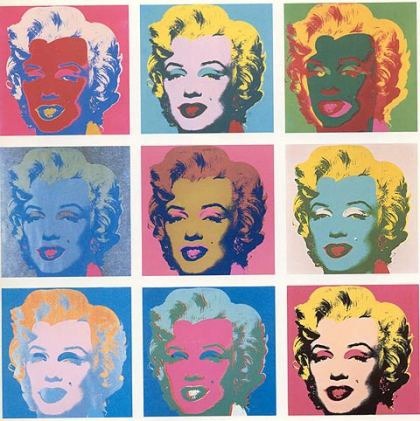
As Christmas is upon us, it may be a adept fourth dimension to reflect on the culture of consumerism that has enraptured the globe. In Walter Benjamin's The Work of Art in the Historic period of Its Technological Reproducibility, Benjamin discusses the mass reproduction of art and its upshot on what Benjamin coined equally the "aura" of the art itself in which the artwork's presence in fourth dimension and infinite is lost through the means of reproduction. The reproduction strips the artwork of its role as an individual unit. Although Benjamin'due south discourse focuses on art itself, using picture show and photography as his main examples, his analysis is applicative to the culture industry itself. Popular civilization is created to function in the all-time interests of the economy and everything is filtered by the civilization industry.
Studying Modern Consumerism and Modern Art
The pick mechanism as to what is authoritatively produced and distributed to the masses is contingent upon investment capital and those who command it. Traces of spontaneity are controlled due to the dependency upon such vast amount of capital in order to be widely distributed.
Culture itself is manufactured. Consumers are classified, labeled, and organized by the manufacturers who view them only as statistics in which more than capital, money, and power can exist gained through further distribution of reproductive cultural entities.
Benjamin begins his discourse with a quote that summarizes how innovation and engineering science have been constantly transforming culture. "Our fine arts were adult, their types and uses were established, in times very different from the present, by men whose power of activeness upon things was insignificant in comparison with ours" (Benjamin, 1051). The quote from Paul Valery alludes to the transformation of art due to technological breakthroughs that revolutionized the distribution and techniques of art itself.
Access to art was severely limited due to technological constraints thus limiting art itself due to the cultural constraints that such confinement, in terms of exposure, acquired. Benjamin'southward discourse begins with a sense of optimism, which deteriorates equally the capitalist mode of product—and its cultural effects—are discussed. With such widespread reproduction of art and culture itself, the aura of the artwork itself is lost along the way as what is considered to be fine art becomes disillusioned amongst widespread reproduction with alternate motives.
Through the capitalist style of product, art becomes intended to suit capitalist interests rather than beingness a unique form of individual expression. Benjamin states that such conditions of mass production "neutralized a number of traditional concepts—such as creativity and genius, eternal value and mystery," (Benjamin, 1052) Benjamin goes on to quote Paul Valery one time again in the first function of his discourse, stating that auditory and visual images became marginalized to something hardly more than than a sign.
The aura of an artwork is lost during reproduction. It loses its "unique existence in a particular place," (Benjamin, 1053). The copying of the artwork detaches its essence from the artist and loses that personal connectedness. Famous artist Pablo Picasso said that "Art is a form of magic designed as a mediator between this strange hostile globe and u.s.a.."
Nearly recently in our civilisation technological innovations take distorted art and disrupted the function that art serves equally a mediator in understanding the world we live in. "By replicating the work many times over it substitutes mass being for a unique existence," (Benjamin, 1054).
Mod Consumerism and Tech
Technological innovations have led to the emergence of new fine art forms such as motion-picture show and photography. In doing so traditional concepts of art have been overthrown and production has overflowed the cultural filter so that art as a form itself loses its own aureola. The traditional concept of the definition of fine art is transformed past such technological reproduction just at the cost of its essence.
Art was becoming so reproduced that it took on unlike goals and approaches such as Dadaist's attempt at counterculture, which somewhen was culminated with the surrealist move. In a more modern sense art has been developed into and then many forms of entertainment to the point in which the aura is and so far removed that information technology lacks whatsoever creative qualities or skills as technological advancements replace or remove these things.
Due to the mass reproduction of art, art has transcended beyond its role as a specialized field of humanism for ameliorate or worse.
Quality has been sacrificed for quantity as mass reproductions of imagery serve different functions without focusing on aesthetic representation in the form of dazzler. Mass reproduction has outmoded the primary necessity for fine art to inhibit specialized techniques and training.
Such exploitative motives ruin art and serve pop civilization only as a means to reinforce elitism amidst the established power. Benjamin cites egalitarianism as the ideological condition for the abiding decay of fine art. '
Benjamin cites two circumstances, "the desire of the present day masses to 'get closer' to things spatially and humanly, and their equally passionate business concern for overcoming each thing's uniqueness by assimilating it equally a reproduction" (Benjamin, 1055) as reasons for the loss of the aureola in question.
Backer motives are the root for such ideologies to proceeds influence over the masses in order to fuel reproduction. Benjamin cites the phrase "l'art cascade l'art" which ways "art for art'south sake," which was a sentiment to preserve the aura as a reaction to the commencement revolutionary means of reproduction and many counter civilization movements have emerged since then.
Benjamin's discourse advocates a sense of optimism with the emergence of civilization manufacture and its role in transforming art. Benjamin cites massive agile participation equally a positive attribute of technological reproduction. He refutes notions that popular culture is a grade of escapism from the drudgeries of commercialism that causes the masses to be docile and subservient to the aristocracy.
Benjamin argues that past advocating contemplation and absorption of such art forms, such art forms are gradually understood and mastered, in other words through dialectics. By constantly searching for truth and maintaining an open mind for resolutions between disagreements, the masses could transcend such seemingly subversive influences equally pop culture.
Modern Consumerism Conclusion
Popular culture serves capitalist interests because of the industries that depend upon it for reproduction. Such industries are indebted to detail ideologies that were formed in guild to preserve and further influence upon the masses. Popular culture is an authoritative outlet for such extensions of influence.
See also Democracy Chronicles Political Art page!
Source: https://democracychronicles.org/how-modern-consumerism-has-changed-art-and-culture/
0 Response to "Mass Media and Mass Production Through New Technology Is Called New Art"
ارسال یک نظر