How to Upload a Website to Webflow

Webflow is ane of many website pattern engines, or website builders, available to the general public. They bill themselves every bit the web CMS for designers considering they offer a platform and an engine rather than the more than restrictive and limited website builders offered by services similar Wix. They're flexible, just can you lot use WordPress with a Webflow website?
The simple answer is yep, yous can. In fact, there are a few unlike ways you lot tin exercise so, with unlike levels of ease of use, drawbacks, and SEO considerations.
The complicated part comes in picking which method you desire to employ. I've pared it downward to four options I see about unremarkably recommended, and I'yard going to discuss each of them in turn.
Option 1: The Bad Thought
The first option I want to hash out is one I've seen mentioned in other articles about this topic. It's a really bad idea these days, and frankly, I'one thousand surprised that people are even so recommending it (in 2020, no less).
What's the thought? Using iFrames to embed a blog. The bones idea is pretty simple: create a WordPress blog, either on a self-hosted WordPress.org installation or on the hosted WordPress.com version, with or without a custom domain, depending on your preference.
Once y'all have a web log up and running, y'all embed it on your Webflow site using an iframe. The code for an iframe is relatively uncomplicated, though yous can also add some dimension specifications, CSS styling, borders, and other options:
<iframe src="https://domainname.com">
What this does is creates an embedded window in your site to the other site. Your blog appears in a frame inside your Webflow site. Users can interact with the blog however y'all allow them to with the frame of your Webflow site around it.
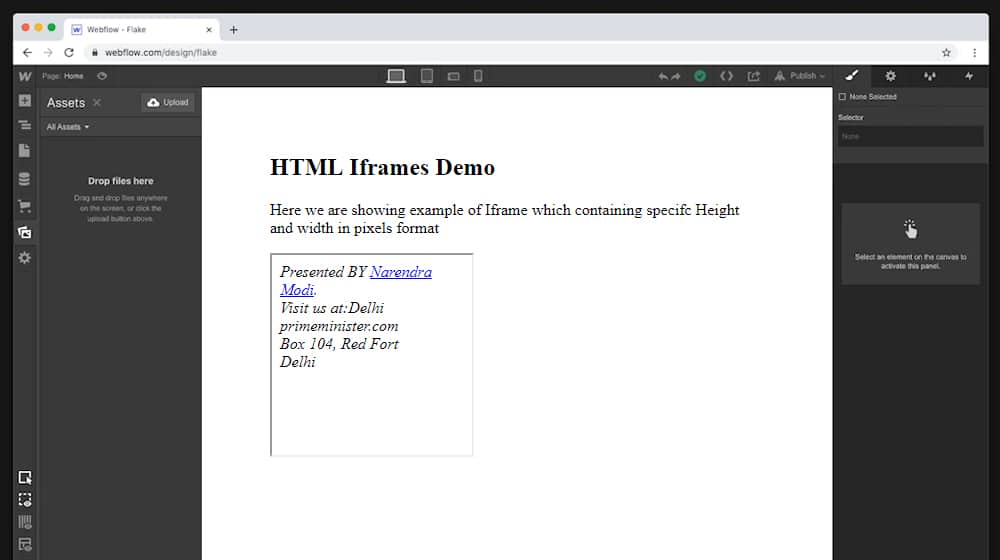
So hither's the thing: iframes haven't been skilful spider web practice for over a decade at this point. They used to be pretty common, and if you've been using the web for a while, you lot probably retrieve them. In that location used to be a whole range of sites that were nothing more than an iframe with a few tools or ads on it, allowing you to browse other sites through their site, while they make money or give you additional features like social bookmarking and what have you.
The problem back and so was primarily abuse. A whole lot of sites did nothing but add a layer of ads around any you're browsing while providing niggling value of their own. Some of the worst ones were more nefarious; they limited the browsing you could practice in the frame to sites in their network, allowed you to earn points while browsing, and spend those points to put your site in the network, for what was basically a traffic scam.
Needless to say, Google wasn't a fan of this kind of abuse, and typically ignores content that is in an iframe. Non skilful, peculiarly when that content is your entire blog.
Now, there are ways to utilise iframes without being flagged every bit spam. In fact, if you use them properly, they're inappreciably a negative signal at all. The trouble is, they don't add much to a site that you can't already get through HTML5, CSS3, or other advanced modern features of web blueprint. They too await and feel onetime, like they're out of date, no matter how you dress them up.
The biggest problem of using an iframe, notwithstanding, is that the content isn't on your principal folio. If you lot're trying to get a Webflow-based website to rank in search, you demand to follow the commandments of SEO, and 1 of those is to populate your pages with rich, robust content.
If you lot have Webflowsitename.com and you desire it to rank, and you want to use content marketing to practice it, you need to have a blog on that site. If you're using iframes, though, your blog volition actually be hosted over on your WordPress site. That is the domain that gets all of the SEO benefits of that weblog content. Your Webflow site doesn't.
Needless to say, I really don't recommend using this pick if you care at all about SEO, search ranking, or traffic.
Option ii: Use a Subdomain
I matter you lot might notice as you read through this article is that I'thou not actually a giant fan of Webflow. It'due south a perfectly fine CMS and site builder, and it'due south ameliorate than using something like Wix or Weebly, merely there'due south non much it can offer you lot that you can't get elsewhere with less hassle.
In fact, Webflow has a few limitations I really matter are close to deal-breakers for a lot of you out there. The limit on the number of pages you lot can build is a large i, and the fact that you lot're capped on traffic based on your package – and thus have to pay more as your site grows in popularity, or else become cut off – is unfortunate.
If you're absolutely married to the thought of using Webflow, and you turn down to change your site architecture or kickoff over on another platform like WordPress directly, your best choice is probably going to exist using a subdomain.
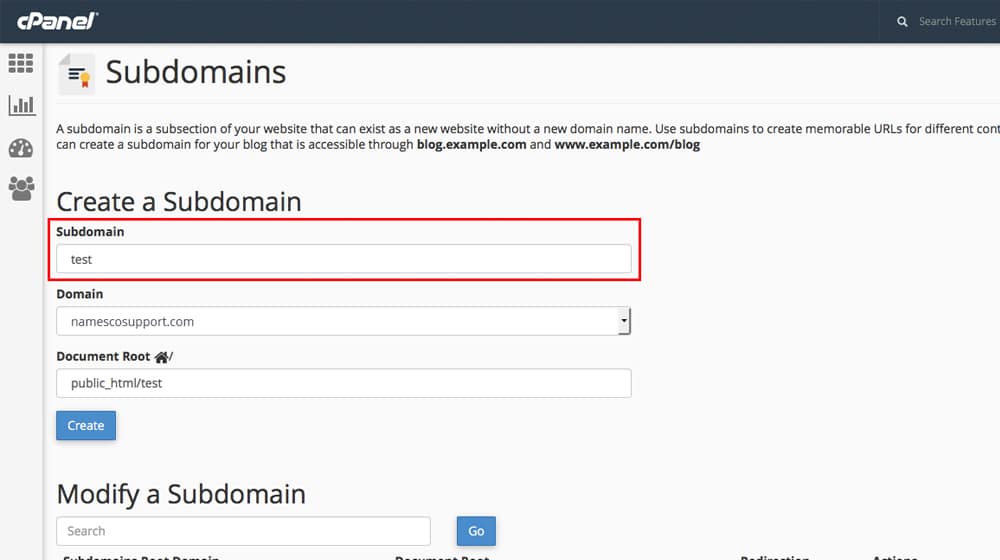
A subdomain is role of a domain separated by a dot. So if you accept a chief Webflow site and y'all want a WordPress blog, you can prepare that blog to utilize blog.webflowsitename.com.
To do this, you'll essentially need 2 sets of web hosting: your Webflow hosting, and your hosting for your WordPress site. Y'all can utilise WordPress.com, merely only if you lot're paying for it then you can employ a custom domain proper name. Your main site volition be hosted on Webflow using webflowsitename.com, and you'll add together a subdomain that uses DNS to send traffic to your WordPress hosting when users visit weblog.webflowsitename.com.
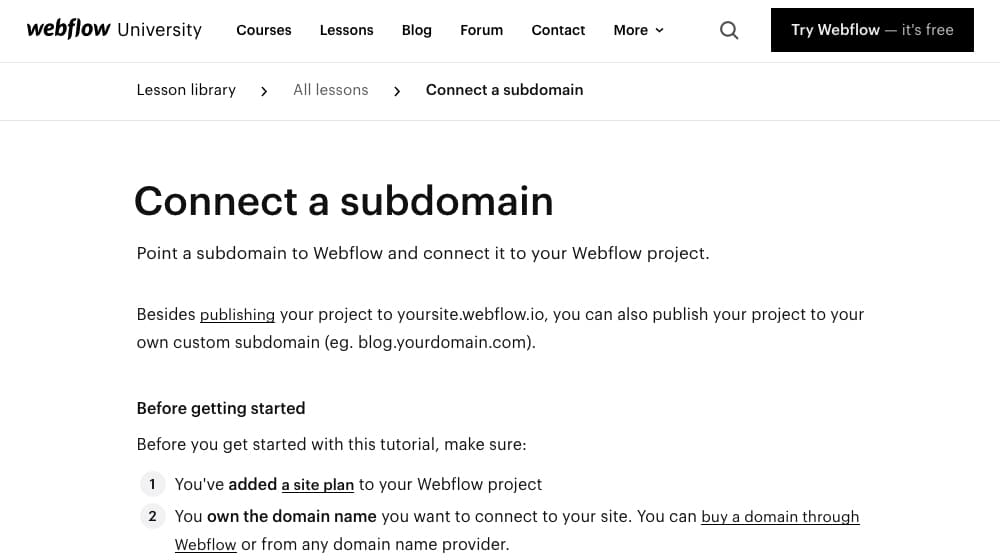
Webflow offers instructions on how to configure a subdomain to your projection. Y'all're primarily looking for the DNS instructions since yous won't be hosting the pages from the subdomain on Webflow; they'll be hosted on your WordPress site.
Now, I generally don't recommend splitting a blog off into a subdomain. I adopt using a subfolder for it since everything is all on the same domain that manner, for the most office. It can exist a bit of an SEO concern, though again, Google is smart enough to recognize a subdomain as an extension of a primary domain and commonly requite them comparable attribution.
There's actually a lot of contend over how exactly a subdomain affects your main domain in terms of SEO. This post is a adept rundown of the details, including both Google'southward give-and-take most it and Moz's tests that refute what Google says:
"Moz yet urge[due south] people to place their content in subdirectories rather than subdomains in gild to maximise their SEO performance."
You can describe your own conclusions, of course. This might only be one small drawback that you'll accept to settle with.
Option 3: Webflow Pages Plugin
If you really desire to use Webflow to host your pages, but you even so desire a blog, probably the best option you have is to build your site on WordPress and just use Webflow for your site Pages, while your blog, blog posts, and architecture are all all running on WordPress.
Is your blog earning you lot business organisation? If not, let'southward fix that.
Nosotros create blog content that converts - not just for ourselves, simply for our clients, also.
We pick blog topics like hedge funds pick stocks. And so, we create articles that are 10x amend to earn the top spot.
Content marketing has ii ingredients - content and marketing. We've earned our black belts in both.
If you run an cyberspace-based business and are looking to scale, schedule a telephone call to speak with our founder:
For this method, y'all demand to set up a WordPress site. Y'all tin theme and blueprint your WordPress site withal you like, and use whatever plugins you lot want to use. Y'all just also demand i crucial slice: the Webflow Pages WordPress plugin.
Essentially, this allows you to design and host pages in Webflow, and utilise those pages as pages in your WordPress site, while everything else is centralized in WordPress. You'll still be using WordPress to update your blog content, to manage comments, and all of that. You're just using Webflow for pattern and folio hosting.
You tin notice the official Webflow Pages WordPress plugin here. It's kept pretty up to date and works with the latest (at least as of this writing) versions of WordPress, so I take no complaints from a technical standpoint.
In your WordPress site, install that plugin. In society to configure information technology and get it up and running, though, you need to get your Webflow API key. You can get this directly from Webflow in your Integrations carte du jour, which I believe is also a paid feature, but I'm not certain. Don't worry; yous don't need to know how to use an API, you just need your access token. Re-create that fundamental to your clipboard.
Go back to WordPress and paste in that API key in the plugin configuration carte du jour, then configure how you desire the pages to work. You can make them static pages or collection pages, you can enable caching, and all that adept stuff.
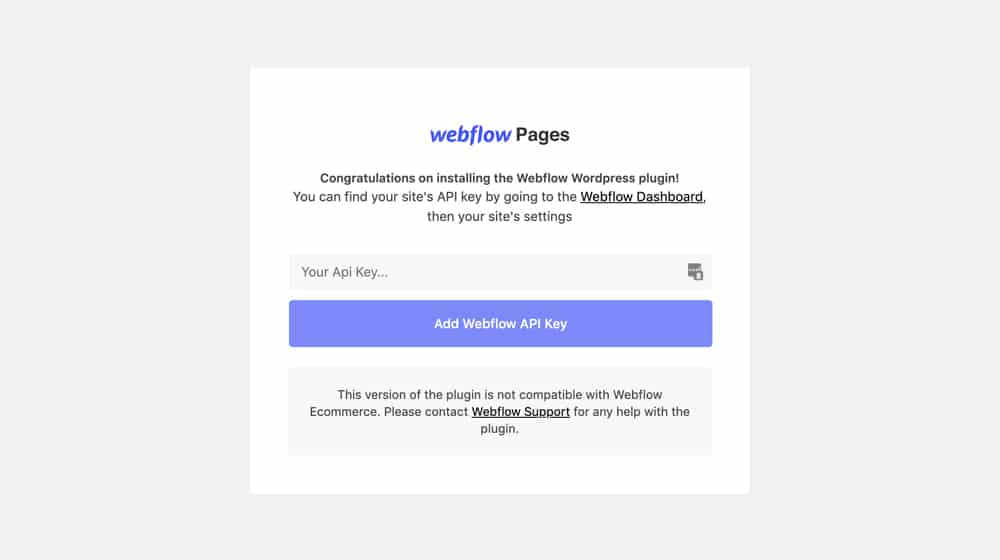
Make and publish pages in Webflow, then choose which and how you want to use them on WordPress. 90% of your site maintenance and updates will be done via WordPress, just to manage those pages or add new ones, you lot will use Webflow.
This is the best choice you lot are able to convert your site to WordPress and want to still host pages on Webflow. If you're fine with merely using Webflow for design and not hosting, y'all take 1 more choice.
Pick 4: Udesly'due south Adapter
If you're not too committed to using Webflow equally the host for your pages, just you beloved their blueprint engine and desire to use it to make your pages (instead of, for example, using WordPress + a theme + a theme editor to customize your site pattern), there'southward a skillful third-party option for you.
As a broad overview, here'southward how this option works. You register your domain and create your WordPress site. You utilize Webflow to design the pages for your website, then you use this converter to catechumen the Webflow page into a WordPress page. This way, your site looks exactly the aforementioned, and you import those pages into your new WordPress site.
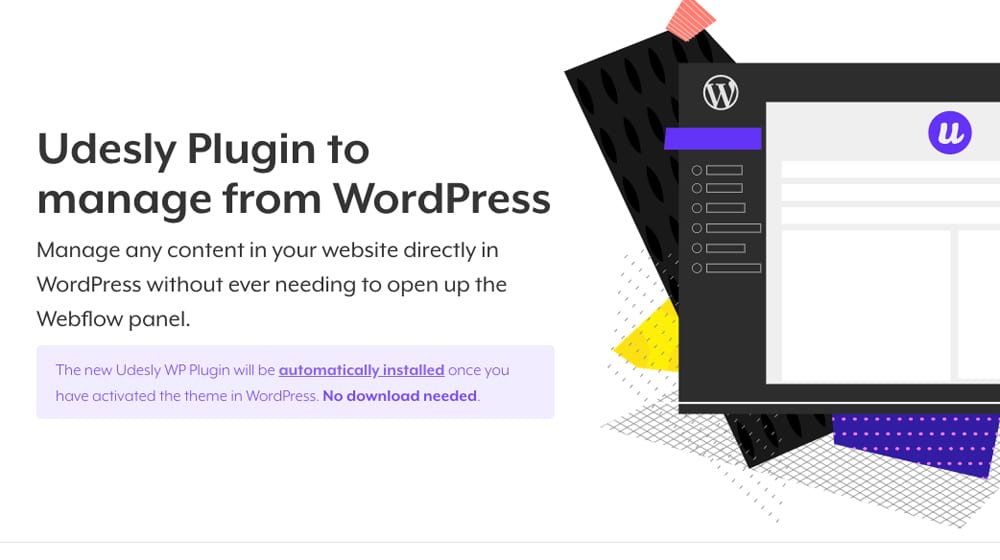
To outset with, you need to use Webflow to design your pages. Since yous're looking at adding a blog to a Webflow site, you probably already have that Webflow site upwards and running, and so this shouldn't be a tall order. If y'all don't already have a Webflow site, you lot take ameliorate options for pattern, what with WordPress having hundreds of thousands of available site design templates out there.
In Webflow, you can export your page code for employ elsewhere if y'all want. Consign that lawmaking, and have it over to the adapter I linked above. Paste in the lawmaking and run the converter, and it will give you code for a WordPress template file.
At present, plain, y'all need to have a WordPress site ready to use this, which means using a self-hosted WordPress.org site so you accept full command over your design, templates, and plugins. You'll demand to utilise the Udesly plugin to import your Webflow->WordPress template, or know enough nigh how to use WordPress templates directly to do it yourself. The converter is available either way, as a web tool or a plugin.
At that place is one major drawback to this pick: the price.
With this method, you lot're getting the worst of all worlds in terms of pricing. Y'all accept to pay for Webflow because the code export option is only available to paid accounts. You don't accept to pay for WordPress, because it's free, but you practise demand to pay for web hosting to run WordPress, plus any paid plugins y'all desire to employ. And, of class, you need to pay seperately for the Udesly converter, which can range from $four to $xvi per month.
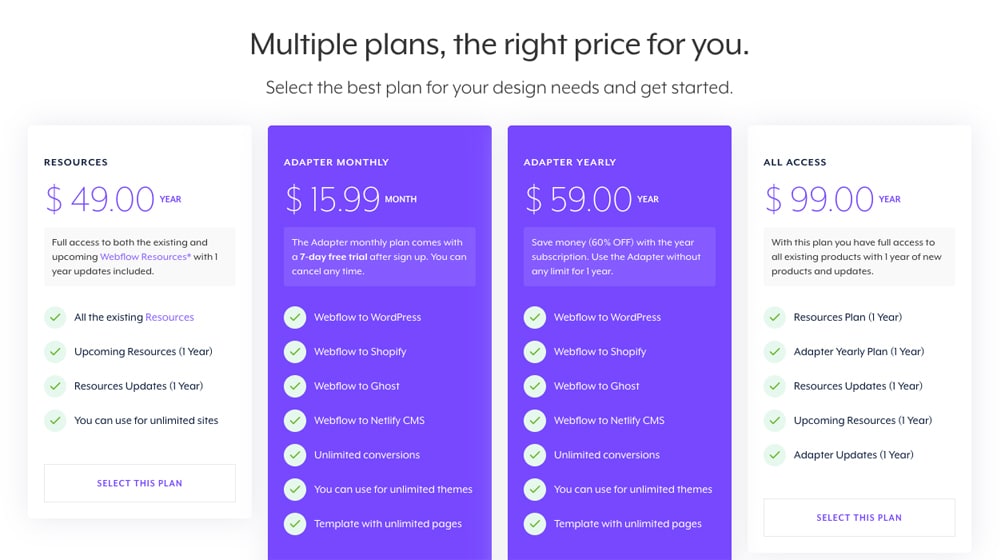
I mean, sure, if you only want to convert a agglomeration of pages once and then drib Webflow, you only need to pay for a month of the converter, become your code templates, and cancel. You aren't required to apply Udesly to run your theme or anything.
Then, as I said; if you're married to using the Webflow designer to design your pages, merely y'all actually want a blog and thus the WordPress blog architecture, this is probably the easiest option bachelor. Having to redesign your site from the ground up is a hurting, and this takes the piece of work you've already done and migrates it for you.
Option five: Total Conversion
Webflow is a keen little blueprint engine, but information technology doesn't necessarily do annihilation unique. If you're able to design this yourself, or if you have a web designer that can help, y'all can move away from Webflow and to a purely WordPress-based site.
This is the best selection if you lot don't really care nigh sticking with Webflow, and only want to utilize whatever architecture is the all-time. Webflow has a Webflow vs WordPress folio, and they're correct most how complex WordPress tin can exist, but they're wrong – in my opinion – to present that as a bad thing.
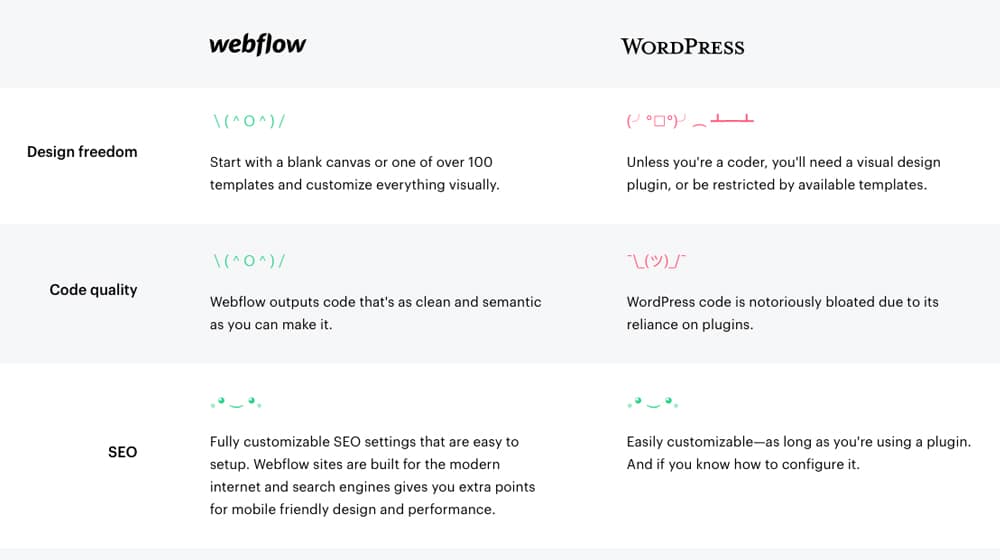
For example, they say WordPress has bloated code due to it'south reliance on plugins, but those same plugins permit y'all to utilise a caching plugin similar WP Rocket which makes WordPress significantly faster than Webflow and take a better Google PageSpeed score. Try testing our site on Google PageSpeed compared to any Webflow site to see what I mean.
A full conversion involves taking annihilation you lot accept on Webflow and either recreating it or converting it with a one-time conversion like the Udesly adapter, and pushing your entire site over to WordPress. All of your pages become WordPress pages, your hosting is your own, your CMS is WordPress, and y'all take complete control over everything.
The biggest advantage of this method is probably the total flexibility. Y'all're not limited in traffic or page count by Webflow when you're no longer using Webflow, and while you might end upward paying for a tool to convert pages, it'due south not an ongoing fee. The but fees yous have to worry about are hosting, domain registration, and any plugins y'all want. Y'all own everything you have, and you are no longer renting.
On the other hand, Webflow is right in that WordPress has a lot going on. Y'all have a ton of control, merely yous need the knowledge to leverage that control, and that has a chip of a learning curve. Of course, if you're enough of a programmer to exist using Webflow in the start place, WordPress is not much more difficult. It's very well worth the tradeoff.
Which of these options seems like the best fit for you, and what are your thoughts on Webflow and WordPress? Will you be converting to WordPress, or sticking with Webflow? Let usa know in the comments below!
Source: https://www.contentpowered.com/blog/add-wordpress-blog-webflow/
0 Response to "How to Upload a Website to Webflow"
ارسال یک نظر